


 Growing Media
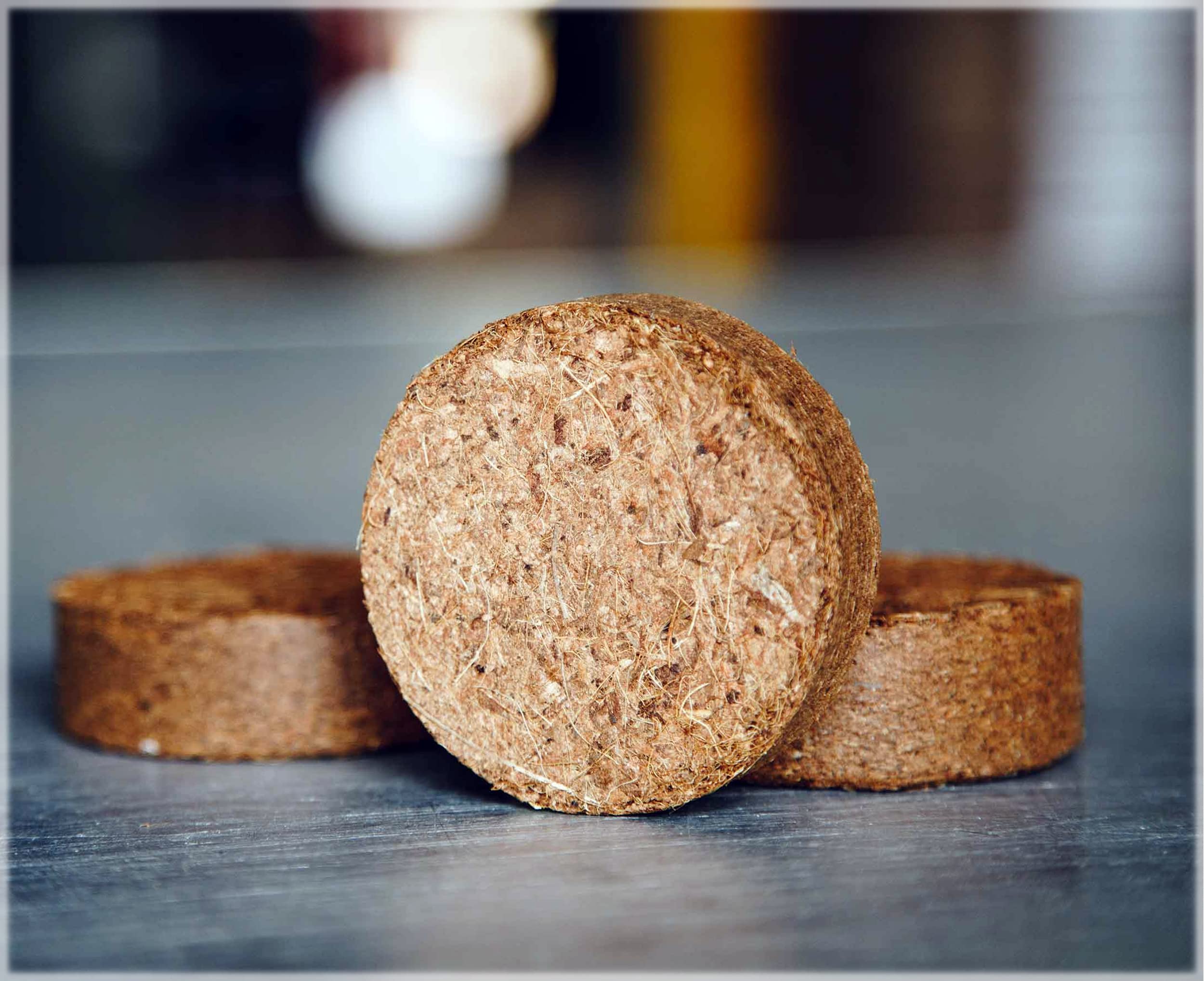
Cocopeat Discs
Pre-formed discs sized to cavity — for operations that skip bulk filling.
View product
Growing Media
5 kg compressed blocks expanding to 70–75 litres. Washed, buffered and EC-tested — because unwashed cocopeat is not cheap media, it is a stunted crop.
Overview
Raw coir pith carries sodium and potassium from the coconut husk and from the water it was processed in. Put a seedling into unbuffered pith and those ions displace calcium and magnesium at the root — the plant stunts, and you spend the season chasing a nutrient problem you built in on day one.
Washing removes the soluble salt load. Buffering goes further: treating the pith with a calcium solution pre-loads the cation exchange sites, so they are not available to strip calcium from your feed later. Washed and buffered are not the same thing, and a supplier who uses the words interchangeably has told you something useful about their product.
What you should ask for is an EC figure, and what you should receive is a batch test. Low-EC grades matter most for propagation, for sensitive crops, and for any hydroponic system where you are controlling feed precisely and cannot afford unknown background ions.
Our standard 5 kg block expands to roughly 70–75 litres with about 25 litres of water. Physically, good cocopeat holds water while retaining air-filled porosity — the combination that makes it a better propagation medium than soil, and the reason it has largely replaced peat in Indian nurseries.
Features
Holds many times its weight in water while staying aerobic — the core reason it outperforms soil in plugs.
Retains structure when wet. Roots need oxygen; saturated media without porosity kills them.
Soluble salts removed, exchange sites pre-loaded with calcium. Not the same as "washed" alone.
You get a number, not an adjective. Low-EC grades available for sensitive crops.
5 kg block ships as a fraction of its expanded volume — the economics of moving media.
A by-product of coconut processing rather than a mined resource with a finite bed.
Specifications
Standard formats below. If you are running hydroponics or a sensitive propagation crop, talk to us about low-EC grades before defaulting to standard.
| Format | Block Weight | Water to Expand | Approx. Yield | Grade / Use |
|---|---|---|---|---|
| Standard block | 5 kg | ~25 litres | 70–75 litres | General nursery, plug filling |
| Standard block | 5 kg | ~25 litres | 70–75 litres | Washed — general purpose |
| Low-EC block | 5 kg | ~25 litres | 70–75 litres | Buffered — propagation, sensitive crops |
| Low-EC block | 5 kg | ~25 litres | 70–75 litres | Buffered — hydroponic systems |
Expansion yield is approximate and varies with block density, water temperature and hydration time. pH typically falls in the 5.5–6.5 range. EC varies by grade and batch — request the batch test with your order rather than assuming.
Applications
Anywhere a rooting medium needs to hold water without going anaerobic.
Advantages
Cocopeat is now the default propagation medium across most of Indian commercial horticulture. The reasons are physical, not fashionable.
Gallery
Industries
FAQ
Washing rinses out soluble salts — mainly sodium and chloride — that come from the husk and from processing water. Buffering is a further step: the pith is treated with a calcium solution so that the cation exchange sites are pre-loaded with calcium rather than sodium and potassium. Without buffering, those sites will strip calcium and magnesium out of your feed solution during the crop, and you will chase a deficiency that has nothing to do with your fertiliser programme. Washed alone is adequate for tolerant crops. For propagation, sensitive species and any hydroponic system, buffered is the correct specification.
Roughly 70 to 75 litres of expanded media with about 25 litres of water. That is a guide rather than a guarantee — actual yield varies with block density, water temperature and how long you let it hydrate. Warmer water and longer soaking give fuller expansion. If you are budgeting media for a large fill, run one block first and measure your own yield rather than working off the label.
It depends on the crop and the system. For general nursery work on tolerant crops, standard washed grades are usually workable. For propagation, salt-sensitive species, and hydroponics where you are controlling feed precisely, you want a low-EC buffered grade — background ions you did not add are ions you cannot account for. The important thing is that you receive an actual batch figure. If a supplier describes their cocopeat as "low EC" without producing a number, that is a marketing claim rather than a specification.
Straight cocopeat works well for many plug and propagation applications. For higher cavity counts, or where drainage needs to be faster, blending with perlite or vermiculite at 10–30% improves air-filled porosity. For longer-term container crops, blends with compost or bark are common. The right blend depends on cavity size, crop and irrigation frequency — tell us those and we will specify rather than leaving you to experiment across a season.
Very little of practical use. It carries some potassium naturally, but you should treat it as an inert physical medium and supply the full nutrient programme yourself. This is an advantage rather than a limitation: you control exactly what the crop receives instead of guessing at a variable background. It is also why buffering matters — unbuffered pith actively interferes with the calcium in the feed you are carefully providing.
Enquiry
Send the crop, the system and your volume. You will get a grade recommendation with the batch EC data — not an adjective.
Related
Products that typically ship in the same order.
Growing Media
Pre-formed discs sized to cavity — for operations that skip bulk filling.
 Propagation
Plug trays from 35 to 104 cavities — specified with the media, not after it.
 Growing Media
 Propagation